Professional skills
Professional Standard
Goal: You apply professional practice, both individually and in teams, in the areas of project organisation, communication with stakeholders, exploratory research, and reporting.
User Study (Interviews)
Introduction: For the branding project each of our group members conducted 1 interview and I made an analys of all interviews.
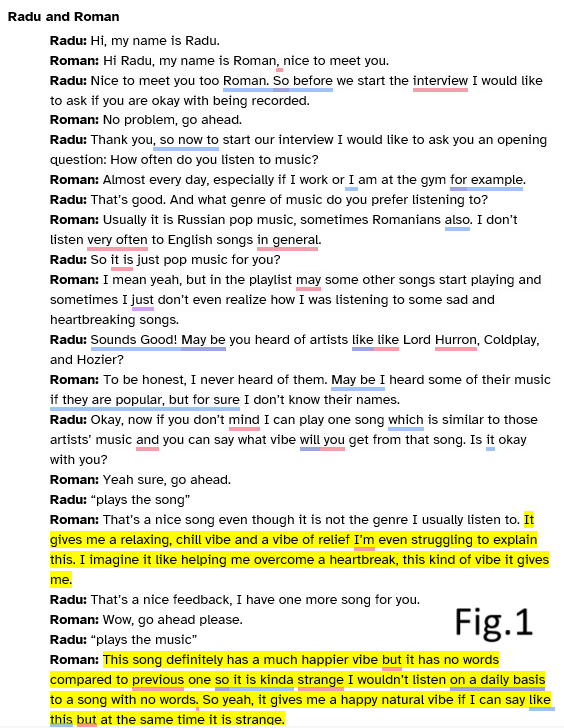
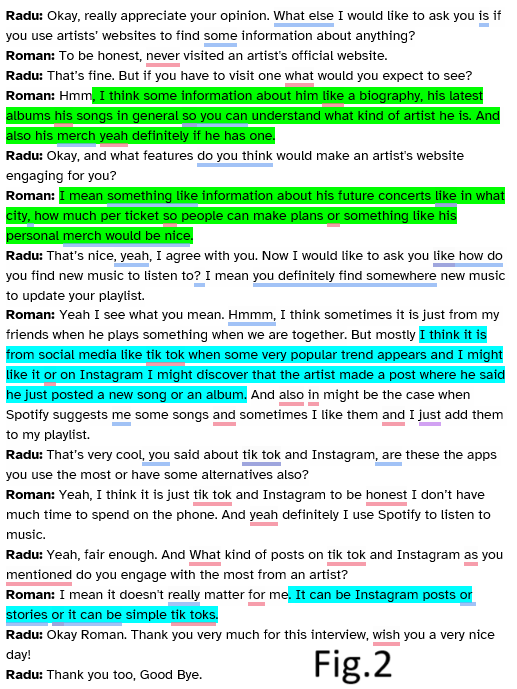
What did I do: For exploratory research we decided to do interviews to better understand this specific topic, addressing a lot of different questions. I conducted one interview with Roman and transcribed it in a word document (see fig.1 and fig.2) for further analys which shows my communication with stakeholders. For the project organisation we divided the tasks equally so each of us must conduct 1 interview. In my interview I asked Roman about the vibe of Owen’s songs to understand potential listeners' opinions. He found the song uplifting but wouldn’t regularly listen to wordless tracks, as they can be boring. This suggests Owen’s audience may prefer songs with lyrics. Roman also shared his expectations for an artist’s website, mentioning a biography, latest albums, and merch options as key features. Additionally, he discovers new music mainly through TikTok trends that last 10–20 seconds, meaning quick engagement is crucial. Owen should use TikTok to promote his music, as many people decide whether to add a song to their playlist in that short time. Overall, my interview findings provided valuable insights for Owen and demonstrated my communication with stakeholders. (A part of this text was shortened by AI as my initial text was too long.)
How did it go: The interview went really well as I was able to gather a lot of usefull information for our client as I explained already above what Roman said which was usefull for us.
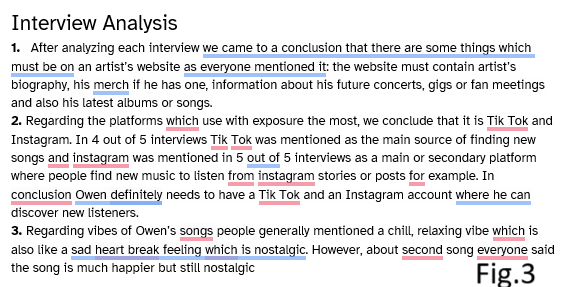
What did I learn: Besides conducting an interview and discussing a subject comfortably, I also learned to analyze the gathered information. I reviewed all five interviews, including my team members’ (see fig.3), to compare our findings. The responses were similar, which was beneficial as all interviewees shared common opinions. Key elements for an artist’s website, according to all interviews, include a biography, merch (if available), details about future concerts, gigs, or fan meetings, and the latest albums or songs (check fig.3 if needed). Another key takeaway was TikTok’s power in attracting new listeners, as a random video can gain over a million views, helping an artist grow in popularity. In conclusion, after making this analys I showed my skills in reporting which is a suboutcome for “Professional Standard” which involves documenting and providing structured reports which I showed and explained above how I did it. (A part of this text was shortened by AI as my initial text was too long.)
User Study (Persona)
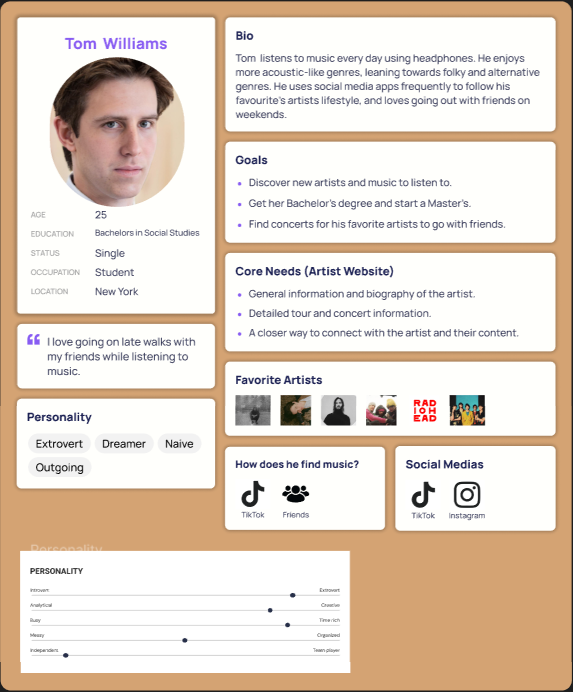
Introduction: This is my own persona for the branding project.
What did I do: We set a goal and divided the task clearly between us that each of us will make his own persona, this shows our skills in project organisation. I made a persona for our project based on interviews each of us conducted. The purpose I made it is to understand all needs of our client and to know for whom am I making a final product. So after analysing people we interviewed I was able to make one universal client who has all characteristics I gathered from other people and put it together which counts as reporting which is a suboutcome and involves documenting and providing structered reports what actually a persona is.
How did it go: It went okay as I was able identify their needs, goals and personality and put it together to form one persona. Which was useful afterwards while doing the final website prototype so I know for whom am I working and what are his needs, personality and how he sees the world around him. As I can’t make a website without knowing my target audience their needs and so on.
What did I learn: I learn how to make a proper persona, how to analyse things in order to make that persona because before making one I need to know from where to take the information and to analyse it so from a group of people who are all our target audience I should select common things from all of them and make one persona. This showed my reporting skills.
Photo shooting
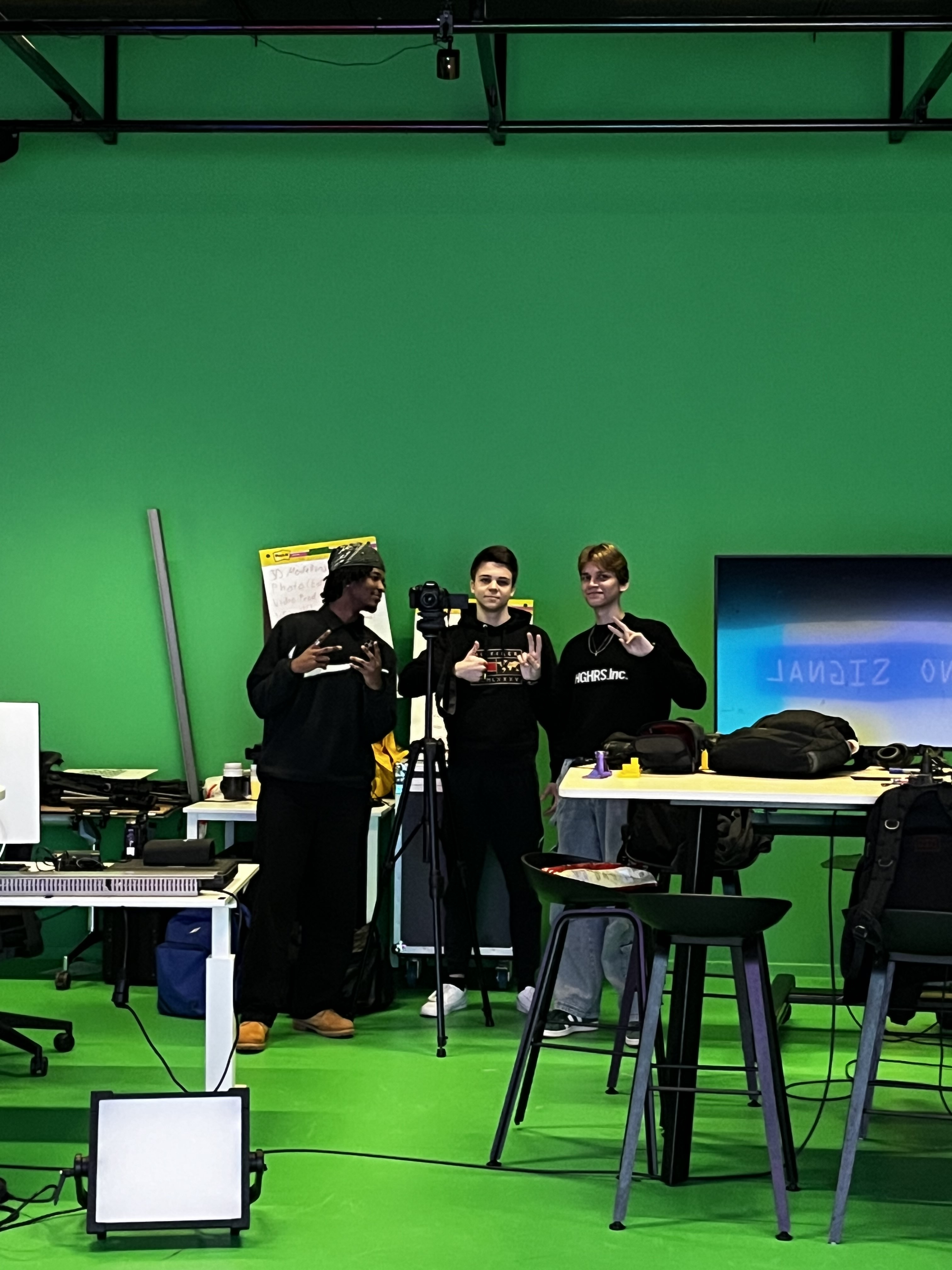

Introduction: We organized a photo shoot in Media Lab for the Branding project with Owen Bryce. The purpose was to use those photos in the design of the prototype.
How did it go: Firstly we had a fake photo shoot without Owen so we can prepare for the real photo shoot. Each of us took part in posing and taking pictures that day, so after that we knew where and at what angle to put the camera, the poses Owen will recreate, how bright was the light. Second photoshoot with Owen went as planned besides we tried some new poses Owen wanted. In general everything was okay.
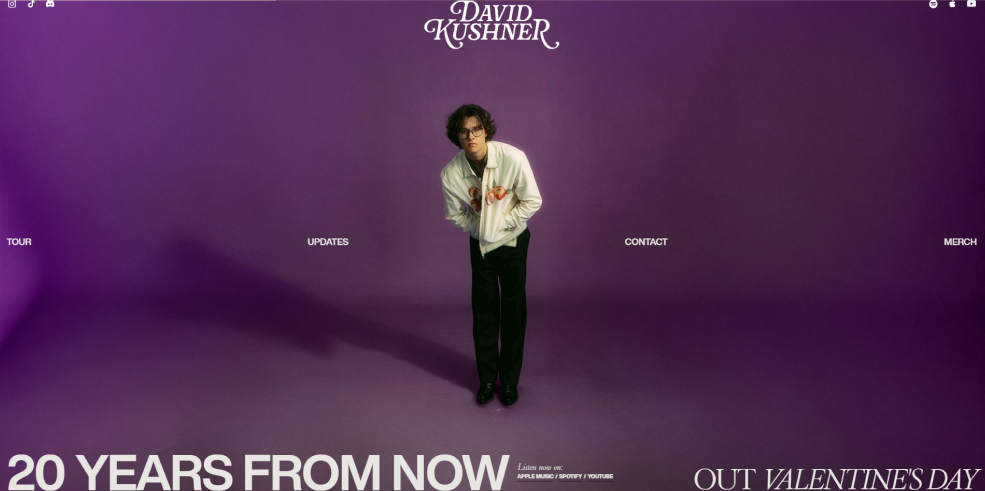
What did I do: We prepared everything for the photoshoot, ensuring it ran smoothly and efficiently, as Media Lab was booked for a limited time and Owen couldn't stay long, so this is how we organized everything which shows the skills in project organization. Also as I mentioned we were able to invite Owen to the photoshoot and explained everything we tried during the last photoshoot and make him recreate the poses to the camera shows the skills in communication with stakeholder. And for proving the exploratory research we made I can say that the whole idea of making the photoshoot came after the research. In fig.3 you can see the website of one of the Owen’s idols whose website we tried to recreate in our own style. It served us as an inspiration and afterwards we thought of taking similar pictures with Owen to use them in the design of the website’s prototype.
What did I learn: After the photoshoot I already have an idea how to use a camera, how to take some proper pictures that I have to take into account the brightness in the background and a lot of small things that affect the quality of pictures. I’m not saying that I already know how to handle all those things, but just know of their existence and in the future it will be easier for me If I will have to take part in a photoshoot again.
Team Charter
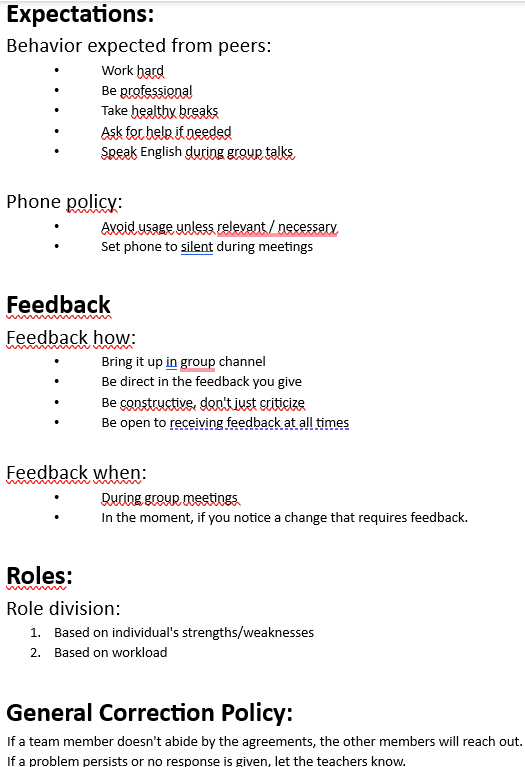
Introduction: I made a Team charter for the Picoo project in semester 2. You can check this word document: Click here.
What did I do: I found a team charter template from semester 1 which teachers provided us with. So I followed that template and answered the questions in group together with my colleagues. We had several sections to answer questions like Time, Listening, Confidentiality, Decision making, Participation, Expectations and others (see fig.1 or you can click on the link above and go deeper into details if needed) So I was the one writing everything down but the decision were made together. In fact the Team charter directly proves the project organization skills that we made different agreements with the team and made a division of roles. Also if you want to see how we divided the work according to sprints, the debriefing (for debriefing you can also check lower all details) and the plan for the project we made after talking to Picoo you can find in our project plan: Click here. We also were aware of risks we have during the project so we wrote everything down in project plan including the preventive measures.
How did it go: The agreements were made pretty easy almost always all of us agreed on particular thing which is good for us to have the same opinion. Project plan helped us mostly with organization so all members are aware what must they do and how much time they have, so in the end we were able to deliver an actual prototype and in the end the implemented version also.
Persona (Picoo Project)
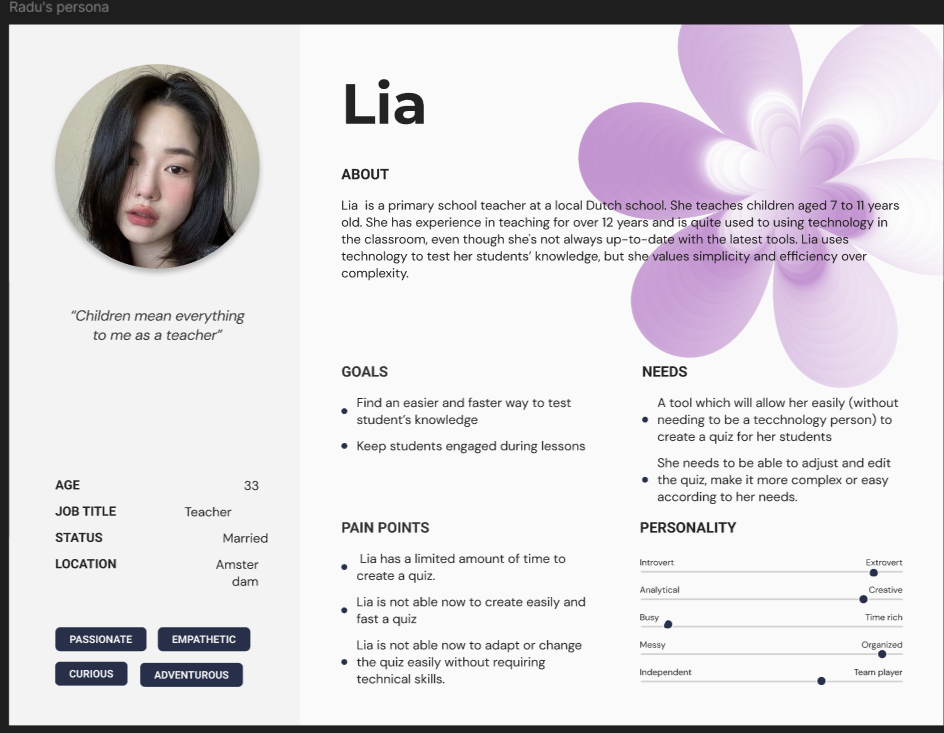
Introduction: This is my own persona for the Picoo project.
What did I do: Firstly, we set a goal and divided the task clearly between us that each of us will make his own persona, this shows our skills in project organisation. I made a persona for our project based on interviews and survey we conducted. The purpose I made it is to gather all information we found together and make one general person who will represent our target audience who will help us understand for whom do we create a website. In fact, all of them have more or less same needs, goals and pain points. Everything explained above shows my reporting skills as I gathered all information and made a structured report (persona in this case).
How did it go: It went good because persona helped me and my group while prototyping and afterwards while developing as I made a prototype based on needs, goals and pain points of my persona. For example, Lia’s needs (check the persona) were to be able to create easily a quiz without requiring technical skills and being able to change or edit the quiz the way she wants. That’s exactly what I have been working on (if needed, check Picoo project (functionalities) proof from Development LO, where I explain what functionalities does my website have)
What did I learn: I learned how important is to make a persona and understand your target audience, because they are the ones who will use our product in the end so if it’s not suitable for them in the end that means we made a useless website. For this not to happen I always need to understand my user and create a persona with their needs and goals after making a research.
Card Sorting and User plan
I performed a card sorting and made a user plan before user testing. If you need more details you can Click here! to go to Interactive Media LO and check the card sorting or if you need to check the user plan you can Click here! where I explain in details what did I do. Still, after Maikel's feedback I decided to also include it here in Professional Standard LO because by doing card sorting and user test I behave as a professional.
Presentations
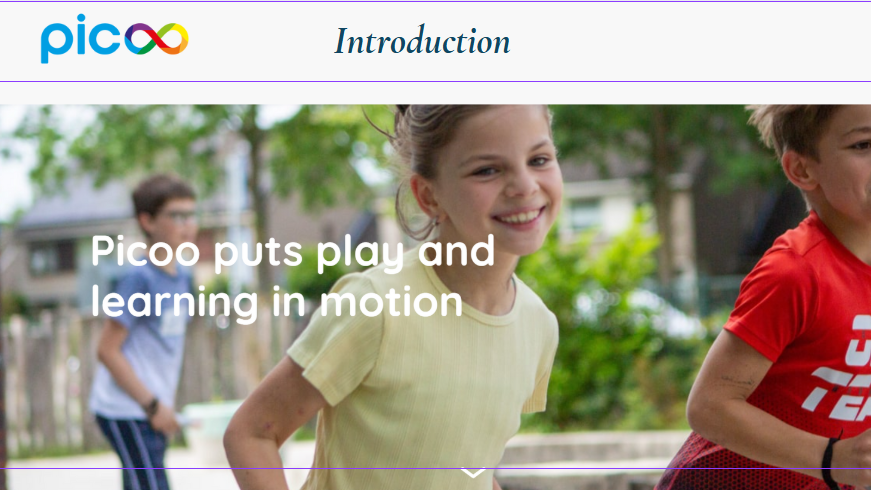
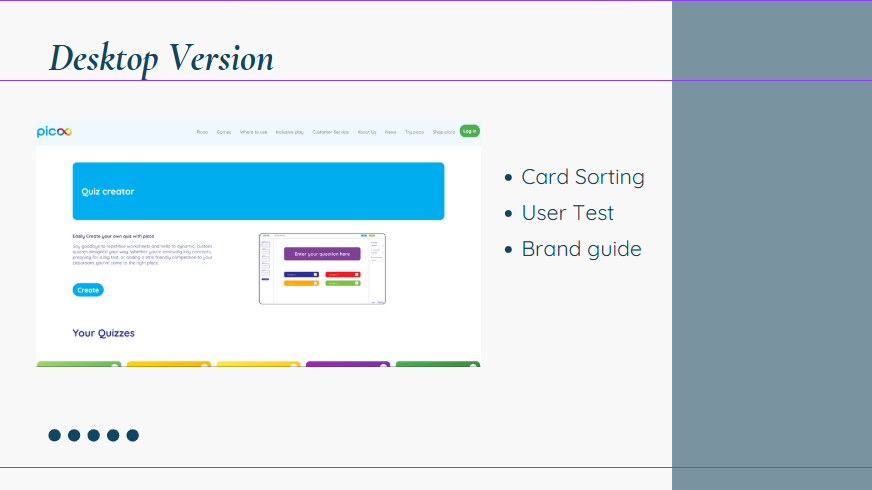
Introduction: I took part in presenting 3 presentations at the end of each project: Branding, Picoo and Development. Everything described here shows my interaction with stakeholder which is a proof for communication with stakeholder suboutcome.
What did I do: For branding project I went to Tilburg with my group and met personally Owen Bryce to show him what we have done. As a group we decided that me and Julian are going to present. If you want to watch the whole presentation on Youtube: Click here. I presented the Introduction and talked about deliverables we completed for him. Next presentation I took part in was for Picoo where I talked about the research we have done. I presented together with Damian and Mitch. If you want to watch the whole presentation on YouTube: Click here. And the last presentation was about developing Picoo project where I talked about Dekstop which I was the only one working on. I mentioned the user test and card sorting I did and also how I followed the existing brand guide rules. In the end I showed a demo version of my website. Unfortunately, we didn’t film the last presentation, but still you can check the slides on the left side I talked about.
What did I learn: I understood that presentations in the end are as important as your product you deliver because the way how you present the product is directly influencing the user’s opinion about your prodcuct. So even if you deliver some really great product, if you aren’t able to present it properly to the user you still fail.
Debriefing
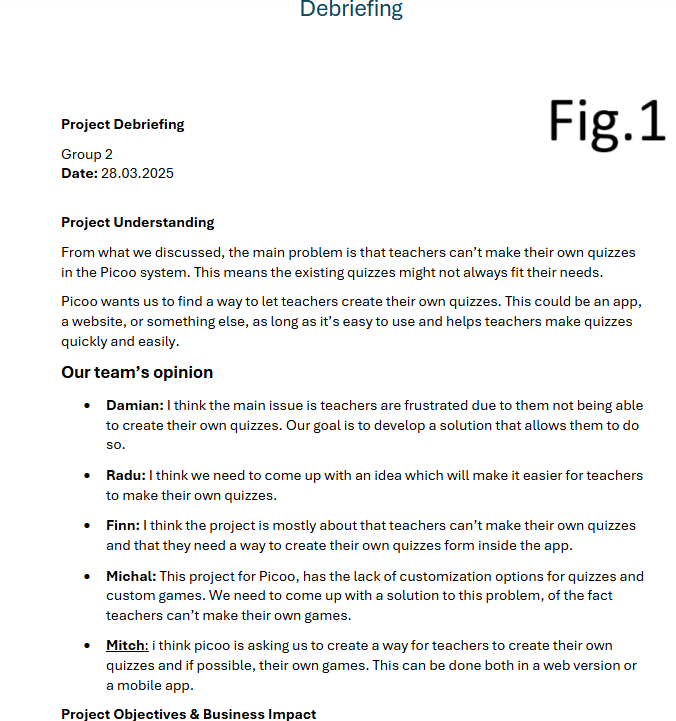
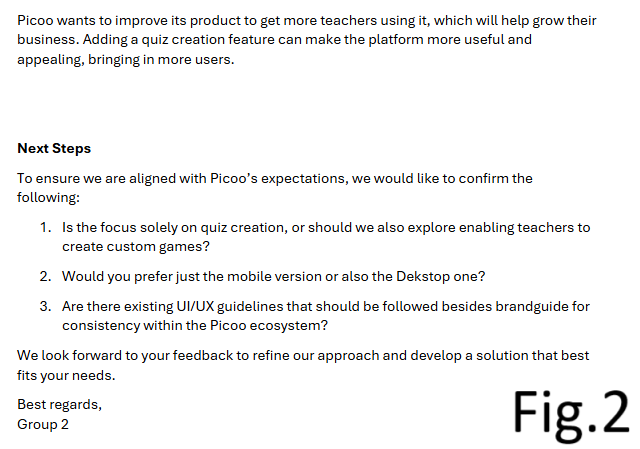
Introduction: I decided to put the debriefing here in the Professional Standard LO to prove the communication with stakeholder and project organization suboutcomes.
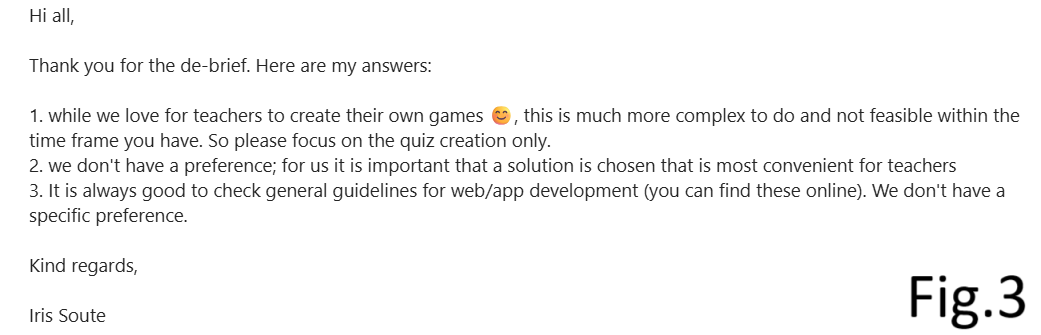
What did I do: I wrote a debriefing for picoo project (check fig.1) which I included in the project plan. I did it next day after picoo presented us their product and introduce themselves so I needed to make sure if I got the idea correctly of what me and my group have to deliver in the end, and this shows the skills in project organization as I’m able to make clear what is our goal as a group. Also, I included in the debriefing some follow up questions for Picoo representer to answer (check fig.2 to see the questions and fig.3 for the answer.) This shows my communication with the stakeholder.
What did I learn: I learned how important it is to get the idea clear and correct before starting to work on the project, because if you misunderstand your client's idea, you will fail with end-deliverables.
Secondary research

Introduction: Besides primary research as interviews, surveys, etc… I also conducted some secondary research for Project X, Picoo Project and design classes with Wouter.
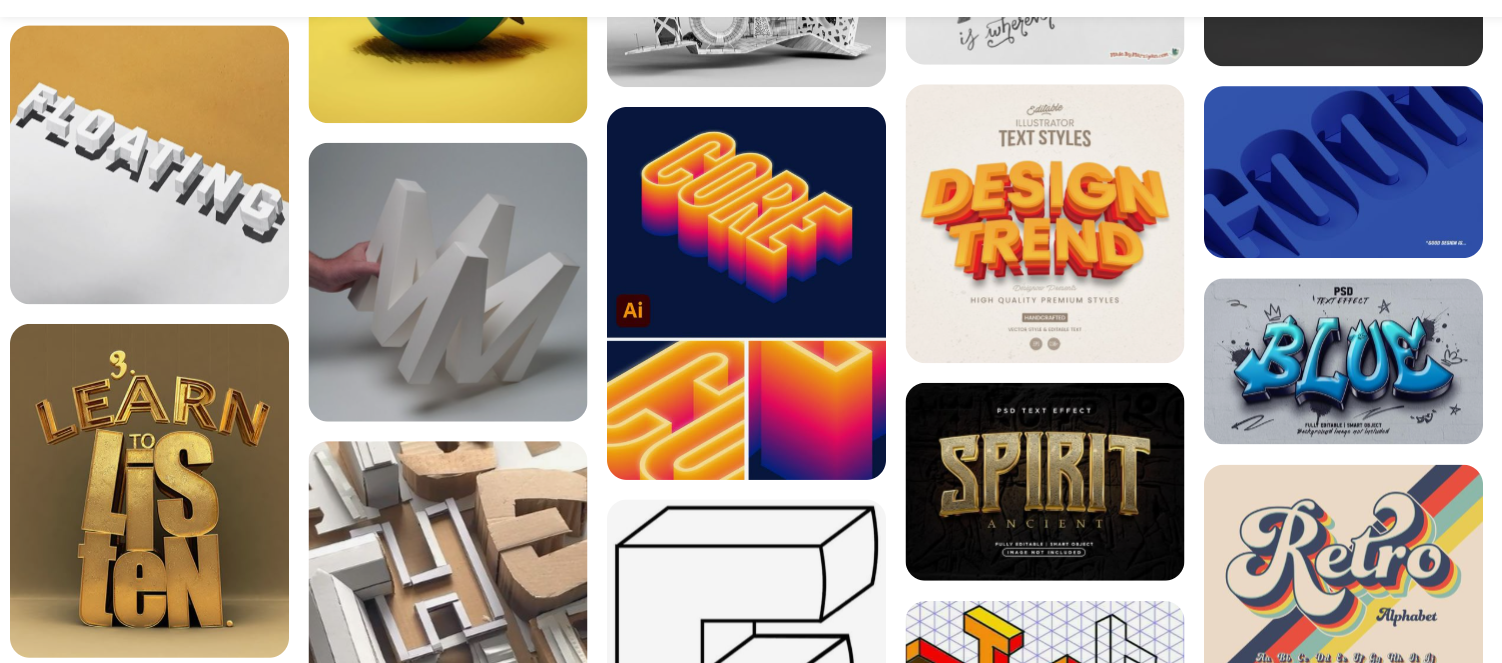
What did I do: For project X I spent some time searching on Youtube for a tutorial on how to make the first project with react framework (Click here if you want to see the tutotial I followed), where I found instructions on how to install react, how it works and some basic functionalities. If you need more details about the project itself you can Click here and go to Development LO where I explain everything in details. For Picoo project I also searched for a tutorial online on how to create a quiz with log in pop up (Click here see the tutorial I found) Obviously that my picoo quiz was way more different than the quiz from the tutorial but still I was able to get the idea on how to make a log in pop up with JavaScript and some functionalities as for example confirming correct answers for each question. For designs I made for Wouter’s classes you can Click here and see in details if needed how I searched for different statistics in order to see for which version should I make the app: mobile or dekstop version. Also I searched for a lot of examples on pinterest to inspire from to make my designs (check the images on the left)
What did I learn: I learned that secondary research is as important as primary one because you should be able to search for information on the internet and gather different insights that will help you with your project.
Personal Leadership
Goal:You take the initiative in asking for, and reflecting on, feedback. You identify your own core values as the basis for your study career and professional development.
Retrospectives
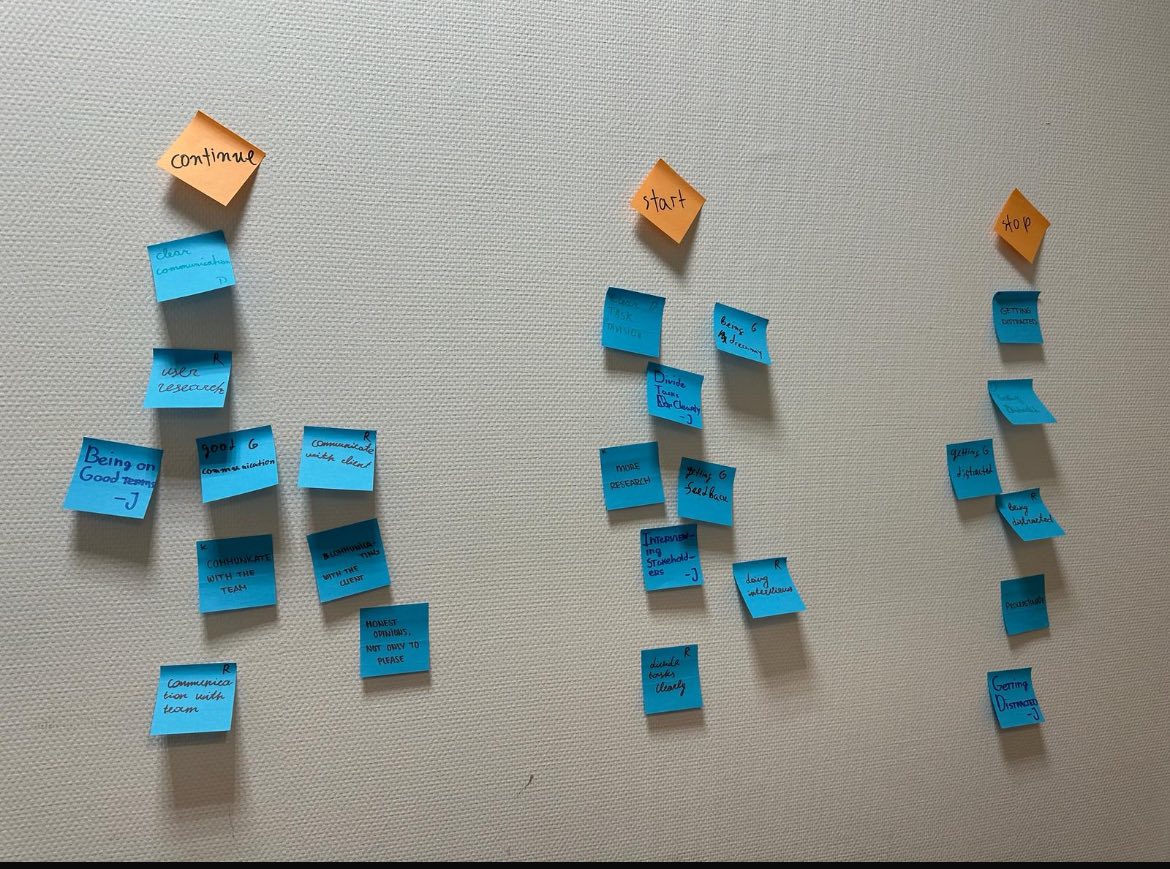
Introduction: Me together with my team made our first retrospective after 1st sprint which last 1 week for the branding project.
What did I do: My teammates and I analyzed what we should continue, start, and stop doing. Each of us added sticky notes for each category—mine, marked with an "R" for Radu, are in black. Since we were conducting user research, I wrote in the "Continue" column to keep working on it due to time constraints. I also emphasized maintaining communication with both the client and team members to ensure everyone stays informed and aligned. For the "Start" column, I suggested beginning interviews, as they were crucial for analysis and persona development. I also recommended clearly dividing tasks so everyone knows their responsibilities. In the "Stop" column, I noted that we should minimize distractions. and when we work in OIL we usually get distracted by talking about things outside the project and in the end we usually don’t finish work in time. I didn’t mean cutting all non-project talk, just limiting it during class to improve efficiency—we can always chat during breaks. (A part of this text was shortened by AI as my initial text was too long.)
How did it go: It went pretty well as all of us participated and discussed during our retrospective and were able to organize all things and actually do what we discussed. For example, one of the things was to finish user study as soon as possible so we conducted our interviews and made an analys in 2 days. Also, we continued communication with our client and even invited him for a photoshoot in media lab. We still were able to keep each other informed about everything going on including when do we come back from holiday and stuff.
What did I learn: I learned how to do a proper retrospective as in 1st semester we didn’t think that deep about it.
Feedback
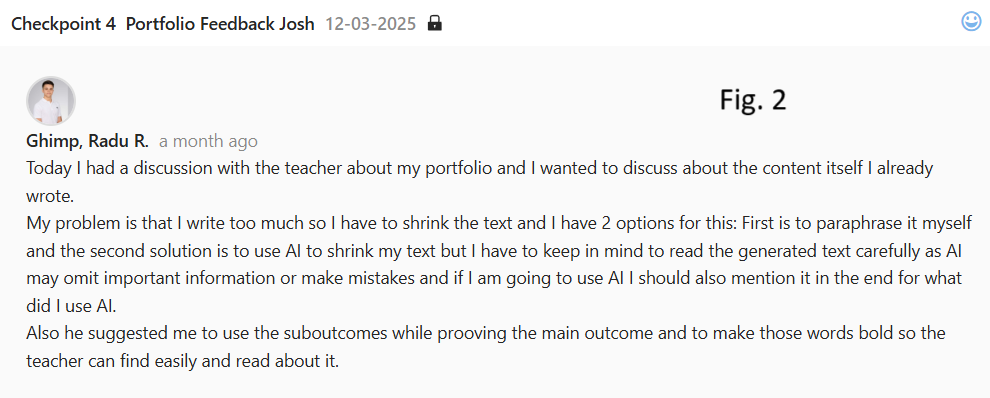
Introduction: I got feedback many times from teachers while doing my portfolio.
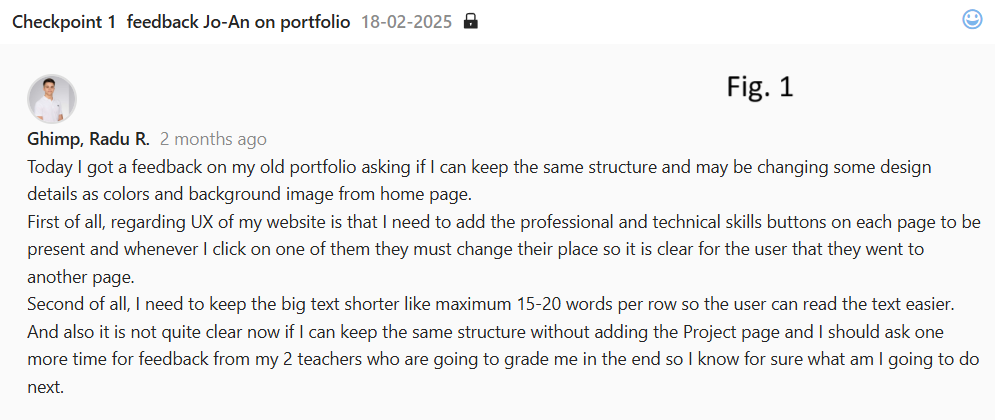
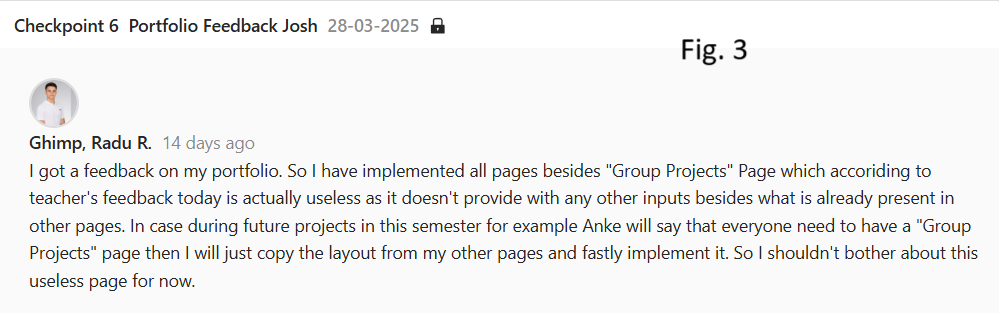
What did I do: Teachers agreed that I can use the same structure for my portfolio as in previous semester. First feedback was from Jo-An (see fig.1) she said to think about UI/UX of the portfolio and change the buttons from the menu which were confusing. Now you can check that I added a drop down menu which is perfect in my case. Another change I made based on Josh’s feedback was summarizing the text more as I had too much text (see fig.2). I decided to use AI for this sometimes. Also I started to make the key words bold so teachers can find it easier (see last sentence of fig.2). In the end I thought that there is no sense for the “Group Project” page and went to Josh for feedback and he confirmed me that I can just leave it (see fig.3).
How did it go: It went pretty good as I upgraded my portfolio a lot by asking and following teacher’s feedback.
What did I learn: I learned how to better structure my portfolio and to keep my content minimalistic not too long. I know how to follow teacher’s feedback.
Core Values
Communication: As I’m someone who wants to become a Front-End developer, I need to keep in mind that communication with my client is one of the most important things I must do in order to create a good quality product. In the first project I communicated a lot with Owen Bryce while doing the moodboard (for more details check “Iterative design” LO proof “Moodboard”) What about second project is that I wrote a debriefing document and sent it to Picoo and got some feedback from them. Also after we have done the survey and sent it to Picoo we got feedback again. Without communicating with your client or user you will not be able to deliver a good product in the end because you will not be aware of needs, goals and personal preferences of the users – the one who in the end will use your product. That’s why communication is crucial for delivering a good quality product in the end.
Curiosity: Front-end landscape is quickly evolving so staying up to date with the latest trends and being curious is an important value to a front-end developer. For this semester my goal is to get better at new things like photoshop, illustrator and learning about UI/UX but actually more interesting I consider for me things related to front end like: Java Script, responsiveness, PHP and obviously HTML and CSS. The thing I’m planning to do for my curiosity is to recreate an actual website I will find online which I am going to like. I will do it during Project X as after working on branding, UI/UX and development project I found out that developing is actually the most interesting thing for me. During project X I’m planning to work on responsiveness and improve my Java Script skills and may be I will find out something new for me to try it out, I don’t know yet.
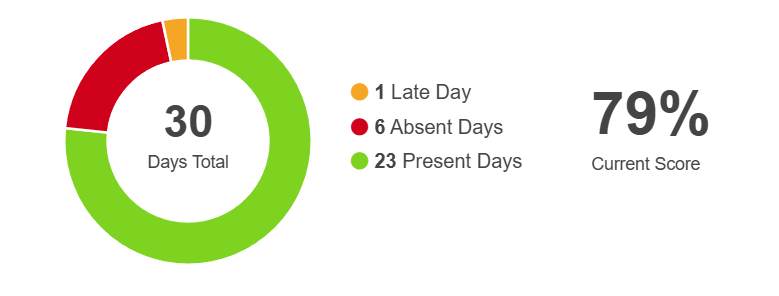
Dedication: During this semester I want to learn as much as possible and not to miss any lectures, especially Maikel’s bootcamps. You can see in the image that I have just 79% attendance, but in fact I was absent because I was still at home with my family in Moldova and this wasn’t because I was too lazy to come to the school. Also during the development project I chose to work just by myself for the desktop version because I wanted to try things out in Java Script for functionality and improve my skills creating a responsive website. I could choose to work with someone else on that project but I wanted to try and see how things work by myself and do more work.
Career Day: The goal and the purpose I went to the career day is to see which specialization fits me the best for semester 3, and in the end if I had time I planned to see which internships are on the market which I might be interested in the future, it was just about my curiosity to see what at what companies I might work in the future. So before going to career day I had 3 choices for next semester: Game design, media creation and front end development. I liked the concept of game design after having a conversation with a techer who told me what to expect from game design but I thought it would be nice to leave it for semester 4 and in semester 3 to do media creation as I liked more to design things rather than programming and I decided to do media creation for semester 3. But after development project which was around one month after career day took place I realized that front end is something I like most, and I decided to change my choice from media creation to front end next semester. Then, during my project X I also started learning react framework to get ready for semester 3. The reason I chose media creation in the beginning is because I was afraid of front end when I heard about APIs, react, a little of back end included also for semester 3 and also I liked designing things. But as I mentioned already during development project I realised I really liked front end especially I enjoyed working on responsiveness and also learning JavaScript during Picoo development project.